Gerald Whitlock
UK tax & pensions — plain English
GUIDE 03 · 2026/27 UK TAX YEAR

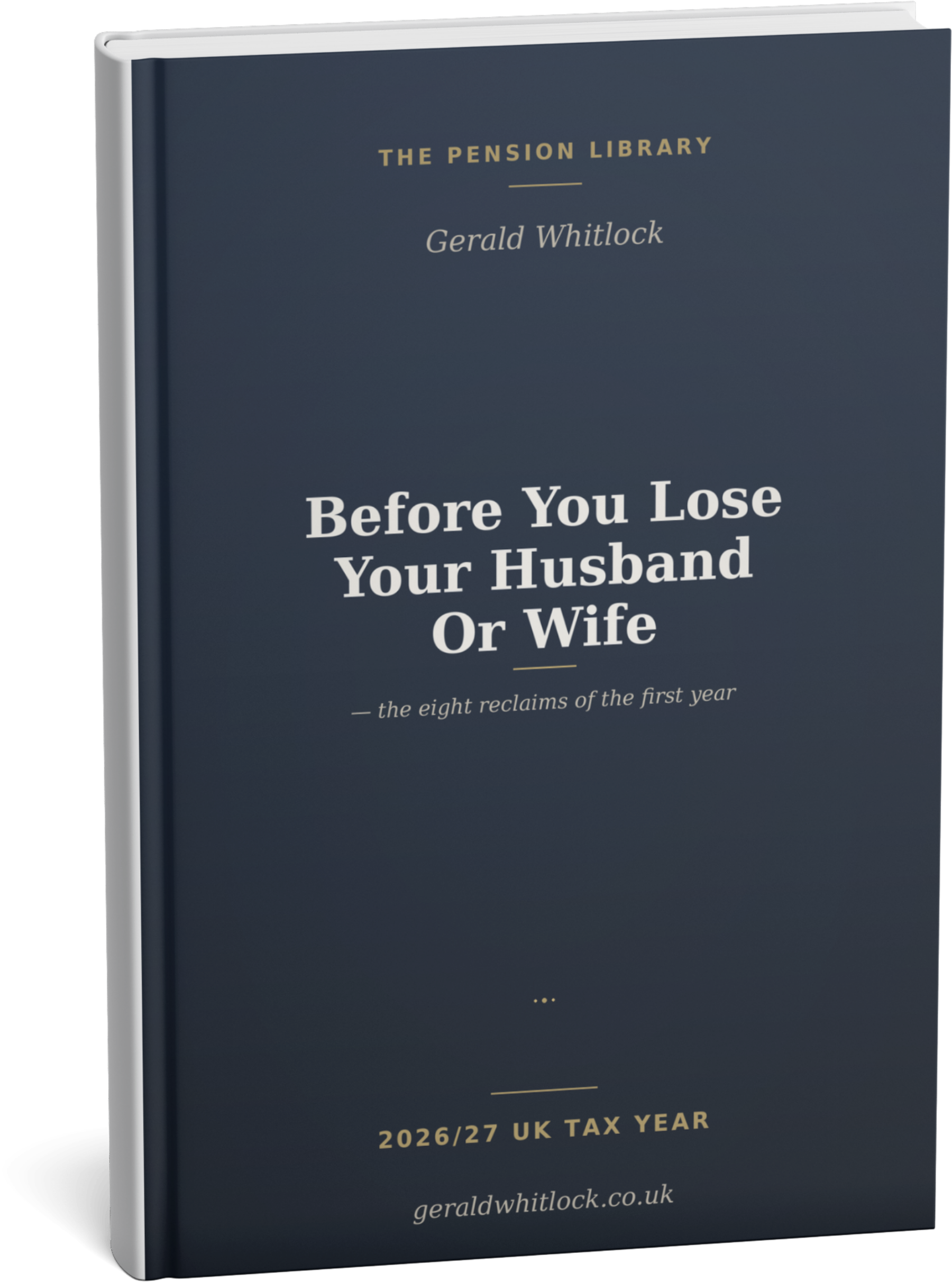
Before You Lose Your Husband or Wife

Presented by Gerald Whitlock, an AI-generated presenter. The rules and figures are real and come from GOV.UK, HMRC and the DWP.

The eight specific reclaims a widow or widower has to make in the first year — and the deadlines most miss because nobody mentions them.
Before You Lose Your Husband or Wife

Before You Lose Your Husband or Wife

  • 36-page PDF, delivered instantly
  • The complete first-year playbook for surviving spouses and widows — written for the person doing the paperwork, not the person grieving
  • The 8 specific financial reclaims, with timelines and procedures
  • 14-day refund policy

£225

Get this guide — £225

Instant PDF delivery. Secure checkout via Payhip. All major UK cards accepted.

When a spouse dies, the financial paperwork begins immediately. Most of it nobody tells the surviving partner about — not at the funeral home, not at the bank, not at the solicitor's office, not at the GP's. The Marriage Allowance reclaim window is closing. The ISA Additional Permitted Subscription has a three-year clock that's already running. Whether any State Pension can be inherited depends on when you both reached State Pension age. It's worth asking the DWP Bereavement Service to check.

This guide is the playbook for the first year of widowhood. It's written for the person doing the paperwork — usually the surviving spouse, sometimes an adult child helping their parent — not for the person grieving. It assumes a clear head, a kettle, and an afternoon.

Many people only find out about these claims years after a bereavement, when some of the time limits have passed. The Marriage Allowance can be backdated up to four years. Some State Pension can sometimes be inherited. An ISA can keep its tax-free status for a time. This guide is the checklist.

This is the checklist. The eight reclaims, in order, with timelines.

What's inside the guide

36 pages. 22 chapters: the eight reclaims, plus the framework around them. The main topics:

Part One — The first 90 days

  1. The Tell Us Once service, the Medical Examiner review, and the calls the DWP and HMRC make first
  2. The DWP Bereavement Service — Bereavement Support Payment, the claim window, and the amounts
  3. The Marriage Allowance reclaim, including the year of death and four prior years
  4. The 25% single-person council tax discount — you need to tell your council and apply

Part Two — The first year

  1. Inherited State Pension — who can inherit, and how to ask the DWP to check
  2. The ISA Additional Permitted Subscription — and the three-year deadline that closes quietly
  3. The Council Tax Reduction reassessment — what changes when household income halves
  4. Pension Credit re-eligibility — including the gateway benefits that come with it

Part Three — The decade after

  1. The transferable Inheritance Tax allowances — IHT402 and IHT436 — and the paperwork to keep, sometimes for decades, so the executor can claim properly
  2. The Lasting Power of Attorney check — because if the surviving spouse has one, life simplifies; if not, this is the moment to think about setting one up

Each chapter has the exact contact route, the exact form name, the deadline, and what to expect.

Who this guide is for

This guide is for you if:

  • You've been widowed recently, and the paperwork is starting to come in
  • You've been widowed in the last few years, and you're not sure whether you missed anything you should have claimed
  • You're a married pensioner thinking ahead — wanting the guide on the shelf for when the time comes, for yourself or your spouse
  • You're an adult child helping a recently widowed parent

This guide isn't for you if:

  • You're not married or in a civil partnership
  • You've been widowed long enough (more than four years) that most claim windows have closed — the guide can still help but several of the eight reclaims will be out of reach

Who Gerald is

Gerald Whitlock is an AI-generated presenter, not a real person. There is no professional title behind these guides: we are not accountants, tax advisers or financial advisers, and nothing here is personal advice.

We made Gerald and these guides because the rules that decide how much tax a pensioner pays, which benefits they can claim and what happens to the family home are all public, but they are spread across GOV.UK, HMRC manuals and DWP guidance, and they are rarely explained in plain English. The guides bring those rules together in one place, with the figures for the 2026/27 tax year.

It matters because much of the system pays out only what you claim. Allowances such as Marriage Allowance and benefits such as Pension Credit have to be applied for, a tax code can be wrong without you noticing, and some time limits can't be put right once they have passed. The guides explain UK rules from public sources — GOV.UK, HMRC and the DWP — and tell you which professional or free service to contact for your own situation. Two of the six guides are only available in the library.

The honest bit

A note about the framing.

This guide is read in two different states by two different kinds of reader.

The first kind is the surviving spouse, recently bereaved, looking at a stack of paperwork they didn't expect. For them, the guide is short, blunt, and structured around what to do this week, this month, this quarter. It assumes very little.

The second kind is the still-together couple, thinking ahead. The husband bought it for his wife, or vice versa. They're reading it in advance, putting the paperwork in order while there's still time. For them, the guide is preparation — the conversations to have now, the documents to gather, the LPAs to set up while both spouses can sign.

Both readings work, and the guide is written for both. If you're reading it in the first state — the recently bereaved one — we want to say one thing directly. Take it at your own pace. None of the eight reclaims are time-critical in the first three weeks. The ones that matter most have windows measured in months and years, not days. Sit down, make a cup of tea, work through one section at a time. Nobody at the bank or the DWP is going to chase you. The system runs on the claims you make, not the ones they remind you to make.

We don't know your specific situation. The guide is general, with figures for the 2026/27 tax year. For decisions about your own circumstances, talk to a qualified accountant, an IFA, or Citizens Advice (which is free and genuinely good at this).

Before you check out — one thing worth knowing

This guide is one of six in The Pension Library. The library covers the rest:

Bought separately, the four individual guides cost £800 together. The complete library is £297 and includes two guides not sold on their own.

Most pensioners reading this guide will recognise at least three of the six worries above. At three, the bundle is the better purchase. The maths is straightforward.

Get this guide — £225 Get the complete library — £297

Instant PDF delivery. Lifetime access.

Common questions

My spouse died several years ago — is it too late?

It depends which claims. Some windows are closed after a few years (Marriage Allowance backdating, ISA APS). Some can still be checked years later, although backdating is limited. The guide covers what's still available even years after a death.

Can I buy this for someone else?

Yes. Many of these are bought by adult children for a recently widowed parent, or by one spouse for the other to keep on the shelf "for when the time comes." The PDF is yours to share with family members.

Does this cover same-sex marriages and civil partnerships?

Yes — the rules apply equally to all legally recognised marriages and civil partnerships. Where specific procedures differ, the guide notes it.

Is this current for 2026/27?

Yes. Figures are taken from GOV.UK for the 2026/27 tax year. Notably, the Bereavement Support Payment rules and ISA APS rules are covered as currently in force.

What's the refund policy?

14 days, no questions asked. Genuinely no questions — this is sensitive content, and if it isn't right for you, the last thing we want is to make you justify a refund.